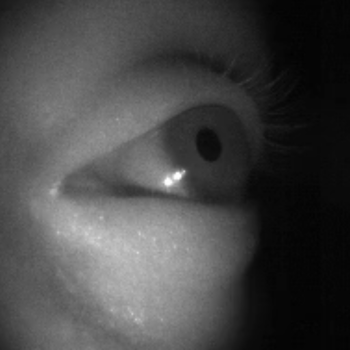
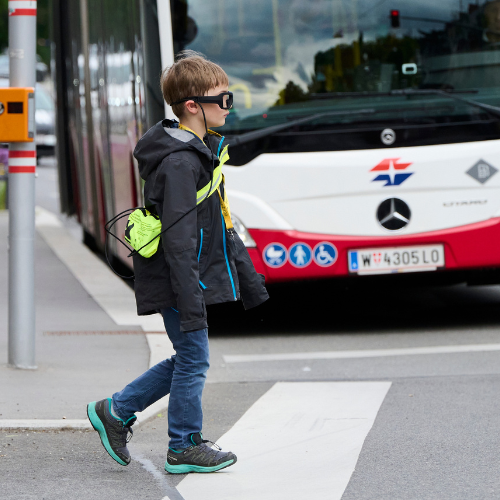
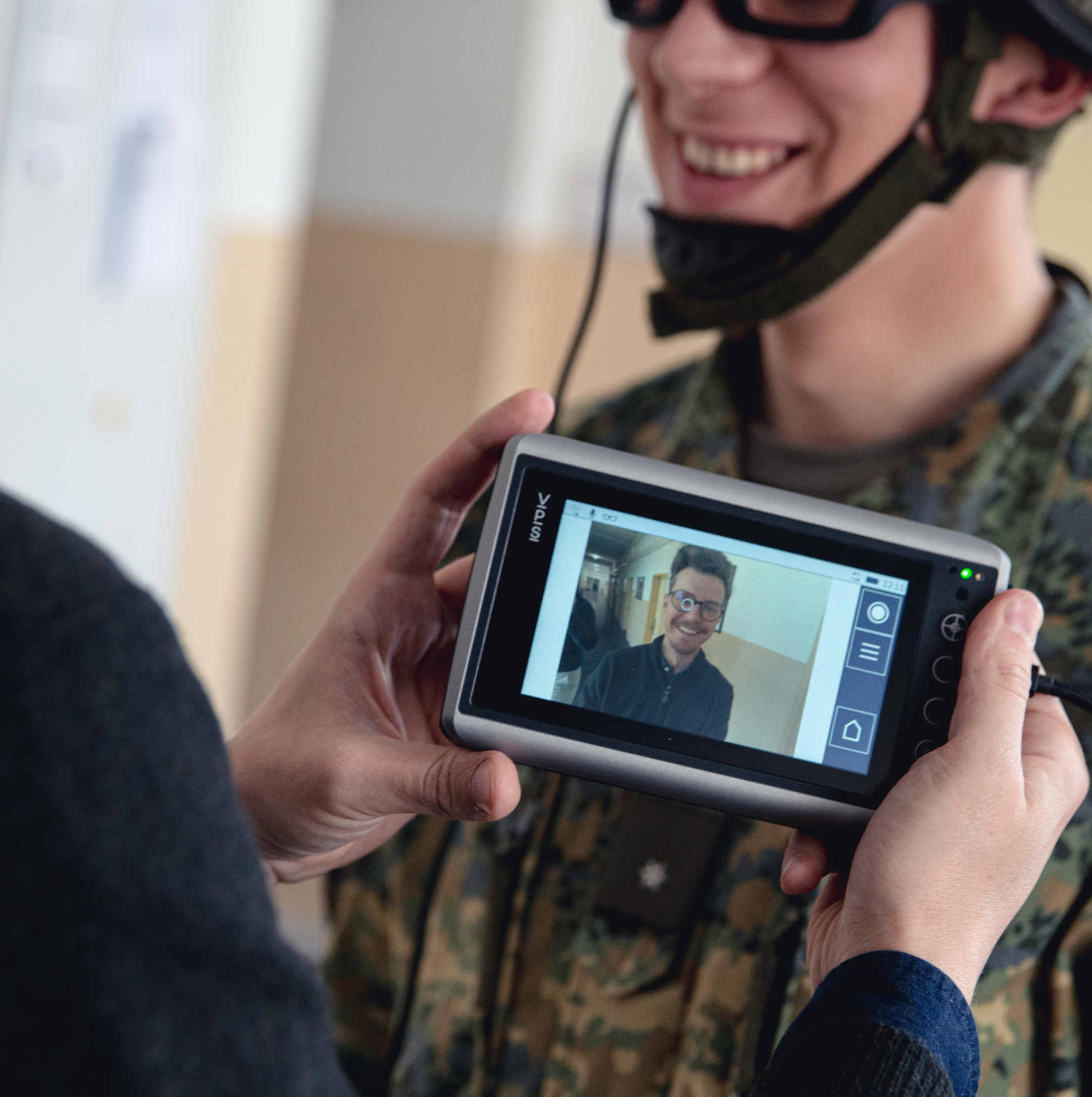
Our collaborative research with Dr. Oliver Rhodes and his team at the University of Manchester (UK), conducted as part of the NimbleAI project, has been published in the IEEE Conference Proceedings. The paper, Neuromorphic Eye Tracking for Low-Latency Pupil Detection (Huebner et al. 2025), presents joint work between Viewpointsystem and the University of Manchester on bringing neuromorphic computing to real-world eye-tracking applications..
The Case for Neuromorphic Eye Tracking
Our eyes are remarkably fast. The human eye can dart across a scene in milliseconds, making it one of the most dynamic organs in the body and a difficult target to track. Yet accurately capturing where we look and when is increasingly vital across fields ranging from healthcare and psychology to augmented and virtual reality (AR/VR), where gaze tracking is key to immersion and interface design. Accurately following the pupil in real time is well within reach, but doing so efficiently – within the strict power and latency constraints of wearable devices – remains an open challenge.
Conventional cameras struggle to keep up with rapid eye movements without blurring the image, and running them at speeds fast enough to capture every flicker consumes far too much power for wearable devices (which demand milliwatt-level efficiency and low latency to be practical). A promising path forward lies in cameras that only respond to movement rather than capturing full frames, paired with neuromorphic spiking neural networks (SNNs), which should deliver exactly the kind of efficient, high-speed sensing these applications require. Yet existing SNN-based approaches have so far been either too specialised or unable to match the accuracy of conventional deep learning architectures, leaving a clear gap.
Our Approach
To close this gap, we redesigned state-of-the-art eye-tracking models to run on neuromorphic hardware, replacing their most computationally demanding components with efficient, brain-inspired spiking neuron layers. The result is a dramatically leaner system – one that performs comparably to its conventional counterparts while using a fraction of the computation. Tested at a sampling rate fast enough to capture even the subtlest flickers of eye movement, our models project power consumption in the milliwatt range and a response time under 8 milliseconds, making always-on, high-speed pupil tracking on wearable devices a realistic prospect.
The Numbers
- Response time: under 8 milliseconds
- Power consumption: projected in the milliwatt range (<5mW)
- Computation: roughly 6 times fewer parameters and 82 times fewer operations
- Tracking accuracy: roughly 4 pixels of error on a standard benchmark
- Testing sampling rate: fast enough to capture even the subtlest flickers of eye movement (1 kHz with 1ms time windows)
Voices from the Collaboration
The DVS camera detects brightness changes at each pixel as they happen, producing fast, sparse event data with high dynamic range and little motion blur. This makes it well suited for pupil tracking, since it focuses on eye movement rather than static parts of the image.Importantly, this comes without abandoning accuracy – our models sustain that ~4-pixel tracking error while running at a fraction of the computational footprint of conventional approaches. While a gap with the very best conventional models remains, the results demonstrate that neuromorphic redesign can preserve most of their performance at a fraction of the computational cost. This is a concrete step toward eye-tracking systems that are fast, accurate, and efficient enough to run continuously on wearable devices.
Dr. Oliver Rhodes:
“As researchers in neuromorphic computing, we focus day-to-day on building brain-inspired systems and algorithms with increased efficiency and processing capabilities. However, it’s only by deploying these on real-world applications that we can fully understand how to advance research.
Collaborating with Viewpointsystem has provided expert domain knowledge around eye- tracking, and by working together we’ve been able to design neuromorphic systems with step increases in performance (in terms of latency and power).
Wearable eye-tracking systems provide a challenging proving ground for the technology, but also the potential for systems which are not only smaller and more efficient, but also capable of extracting more information from the eyes and their movements, due to the increased dynamic processing capabilities and reduced latency.”
Dr. Alejandro Gloriani:
“At Viewpointsystem, we spend our days making eye tracking work in demanding environments – for pilots in flight simulators, train drivers or workers on industrial lines. That hands-on experience with what the technology actually needs to do shaped this collaboration with the University of Manchester in the context of the NimbleAI project.
What makes this collaboration stand out is that it worked in both directions. We brought the eye-tracking expertise and the application constraints; Manchester brought the neuromorphic architecture expertise. Neither of us could have closed this gap alone, and the NimbleAI project created exactly the right environment to do it – the time, the partners, and the shared ambition to move neuromorphic computing from laboratory demonstrations toward deployable systems.
The next step is clear: optimising these models for commercially available neuromorphic processors. But beyond the roadmap, I think this work signals something broader for the eye-tracking field. For years, the community has been constrained by the physics of frame-based cameras – their power draw, their latency, their inability to keep pace with the fastest eye movements. Dynamic Vision Sensors (DVS) paired with spiking neural networks (SNNs) dissolve those constraints. The applications that become possible as a result are ones the industry has wanted for a long time but couldn’t build efficiently enough to be practical. Within the NimbleAI project, we think we’ve taken a meaningful step toward making them real.”
Presented at NICE2026
This work was presented by Dr Oliver Rhodes to the wider neuromorphic community at NICE 2026 – the Neuro Inspired Computational Elements Conference – held March 24–26 in Atlanta, US (https://niceworkshop.org/nice-2026/)
Oliver Rhodes, University of Manchester:
“It was great to present the pupil detection work to the wider neuromorphic community at NICE2026. Researchers in the field are always on the look-out for new applications, and event-based wearable eye -tracking, aiming to capture fast and unique dynamic eye movements, is ideally suited to the low-latency and low-power capabilities neuromorphic systems.”
About the NimbleAI Project
NimbleAI was a three-year EU-funded research initiative, concluded in March 2026, supported by the EU’s Horizon Europe Research and Innovation Programme (Grant Agreement 101070679). The consortium brought together 19 companies and research institutions across eight European countries to advance neuromorphic computing for real-world applications and understand the design trade-offs in building neuromorphic systems – hardware that takes its cues from the way eyes and brains process visual information efficiently.
Standard chips treat all incoming data equally, regardless of whether it carries anything meaningful. Nature works differently – the human visual system, for instance, is highly selective, reacting only to what actually changes in the environment. Sensors built on this same principle, known as dynamic vision sensors (DVS) or neuromorphic sensors, register scene changes rather than capturing full images at fixed intervals. NimbleAI asked whether this biological logic could be realised in a new generation of 3D integrated chips, where sensing and computing layers are physically combined to enable leaner, faster, end-to-end visual processing. For more on how neuromorphic chips work and what they mean for the industry, see our earlier article, The Future of Computing: Neuromorphic Chips and Their Benefits for the Industry.
More information about the NimbleAI project: www.nimbleai.eu