From the participant’s own line of sight, wearable eye tracking captures every fixation – even the ones beyond conscious awareness – turning visual attention into a frame-by-frame record of what catches the eye and how people react.
The new VPS Next
– Discover Now
Research-grade eye tracking, usable anywhere.
Mobile and deployable anywhere: For both static and dynamic scenarios
Lightweight and comfortable: Glasses designed to stay unobtrusive for participant
Robust and precise: Reliable data across all lighting conditions and during movement
Ready to use instantly: Intuitive operation, auto-calibration, or one-point calibration in seconds
Excellent reliability: 1,8° accuracy out of the box, and 1,2° after a one-point-calibration
Complete data control: Access to raw unfiltered data
Suitable for everyone: Reliable performance across diverse users and individual characteristics
ONE PAIR OF GLASSES.
MANY APPLICATIONS.
UNDERSTANDING BEHAVIOR
Eye tracking captures where, when, and how long people look – an objective, high-resolution record of visual attention that often operates faster than conscious thought and beyond self-report. Because gaze is tightly coupled to cognition, information processing, and decision-making.
Combined with modern wearable hardware, it brings laboratory-grade rigour into naturalistic environments, supporting both fundamental research on perception and applied studies of real-world.
Contact us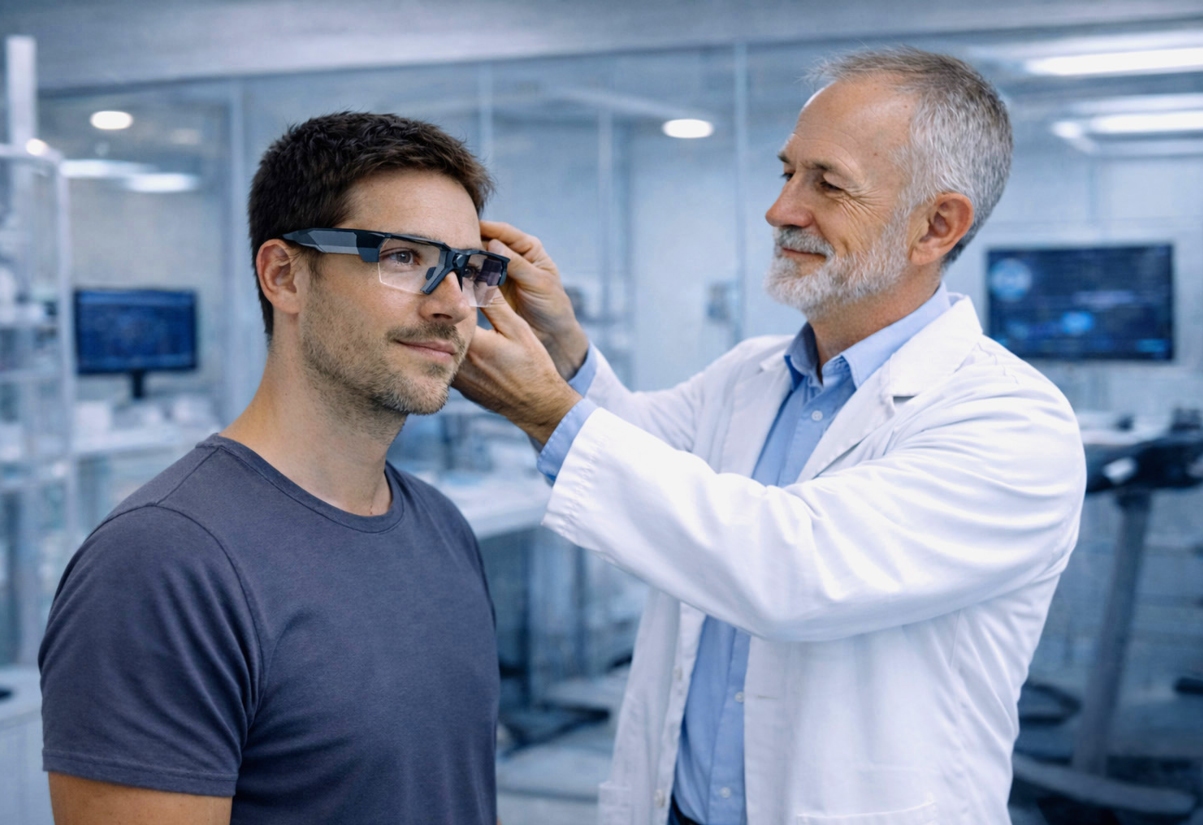

UX – THROUGH THE USERS’ EYES
With eye tracking, UX teams gain a true view of how users experience interfaces and digital products. Fixations, saccades, and gaze paths highlight where navigation feels intuitive and where friction, distraction, or cognitive overload occurs.
Whether for usability testing, prototyping, or interface optimization, eye tracking reveals which elements actually capture attention, enabling targeted design improvements before launch.
Contact usMARKETING THAT DELIVERS IMPACT
How do customers experience shopping, and how effectively do advertising and other factors influence their purchasing decisions? Eye tracking reveals which messages truly resonate—whether in-store, online, or on posters.
Fixations, heatmaps, and areas of interest (AOIs) show what captures attention and what drives purchasing choices, enabling precise optimization of advertising, packaging, signage, and store layouts.
Contact us

OPTIMIZING ROAD SAFETY
In driving simulations, tests, and real-world traffic, eye tracking reveals how road users react, prioritize, and perceive risks. It’s ideal for analyzing distraction, situational awareness, and critical moments.
Eye tracking is particularly valuable for evaluating driving tasks, driver-assistance systems, and designing safer mobility concepts. It can also be used to optimize traffic signs and informational signage with precision.
Contact usPowerful Eye Tracking. Clear Insights.
Our eye-tracking technology combines scientific accuracy with real-world usability. It delivers reliable gaze data in dynamic environments, is ready to use instantly, and provides full access to all raw data. This allows for precise understanding of perception, attention, and behavior—mobile, robust, and suitable for a wide range of users.
READY TO USE INSTANTLY
Auto-calibration gets you started in seconds.
PRECISION EVERYWHERE
Reliable gaze data, even in motion and changing lighting conditions.
FULL DATA CONTROL
Fast visualization and access to all raw data.
Eye tracking SPECIFICATIONS
Eye tracking technology
Binocular dark-pupil tracking (using neural networks) and eyeball modeling
Calibration
Auto-calibration, one-point calibration, automatic slip compensation
Accuracy
AUTO-calibration: 1,8°
One-point calibration: 1,2°
Precision
0,16°
Sampling Rate
60 fps per eye
Provided Data:
- Raw and unfiltered
- Stored locally
- Available live via API
SOFTWARE-Partner
SCIENTIFICALLY VALIDATED

GUI evaluation using eye tracking: Optimizing instructor station for night vision training in aviation.
Sackl, R., & Mõttus, M. (2025). In Proceedings of the 36th Annual Conference of the European Association of Cognitive Ergonomics (ECCE 2025) (Article 33, pp. 1–2). ACM.

Die Auswirkungen digitaler Benutzeroberflächen auf die Effizienz und Effektivität militärischer Einsatzbewältigung: Eine Untersuchung am Beispiel des virtuellen Bedienteils für das Funksystem „CONRAD“ des Österreichischen Bundesheeres.
Pieh-Sandpeck, P. (2025). Masterarbeit, Wien.

Attention performance classification based on eye tracking and machine learning.
Vulpe-Grigorasi, A., Kren, Z., Slijepčević, D., Schmied, R., & Leung, V. (2024). In Proceedings of the 17th IEEE International Scientific Conference on Informatics (Informatics 2024) (pp. 431–435). IEEE.
Differences in visual behavior and cognitive load between experts and novices in medical emergency simulation.
Plank, C. F. (2024). Masterarbeit, St. Pölten University of Applied Sciences.
A mixed-method eye-tracking study on the influence of luminescent floor markings on users’ search path and ease in reaching the emergency exit: A pilot study.
Säckl, M. (2024). Masterarbeit, St. Pölten University of Applied Sciences.

Video-based reflection on neonatal interventions during COVID-19 using eye-tracking glasses: An observational study.
Wagner, M., den Boer, M. C., Jansen, S., et al. (2022). Archives of Disease in Childhood – Fetal and Neonatal Edition, 107, 156–160.

MMDVS-LF: Multi-Modal Dynamic Vision Sensor and Eye-Tracking Dataset for Line Following.
Resch, F., Farsang, M., Grosu, R. (2024). CPS, Technische Universität Wien (TU Wien), Austria.
YOUR PROJECT. OUR EXPERTISE.
Talk to our team: Our roots are in research, backed by years of experience in planning, conducting, and supporting scientific eye tracking studies. We guide projects from concept through analysis and serve as a trusted partner for research teams.
