Measuring it accurately has traditionally required a lab, though, with the head fixed in place and the eyes tracking a controlled target. A new method presented by Viewpointsystem researchers changes that, enabling real-time VOR classification during natural, unconstrained movement using nothing more than a wearable eye tracker.
What Is the VOR, and Why Does It Matter Clinically?
The vestibulo-ocular reflex is driven by input from the semicircular canals and otolith organs. When the head moves, the VOR moves the eyes at matching speed in the opposite direction, keeping the visual target stable on the retina throughout the motion. Its latency is remarkably short on the order of 7 to 15 ms in healthy humans, far faster than visually mediated eye movements, which take upwards of 75 ms to initiate.
VOR doesn’t fit neatly into the discrete categories typically used in eye-movement research, like fixation, saccade, or pursuit. It can combine additively or compositionally with other eye movements. A VOR-like component can overlay ordinary fixational drift, or it can co-occur with pursuit when someone tracks a moving target while their head is also in motion, a phenomenon known as VOR cancellation. That makes VOR harder to classify than most other eye movements, and it’s part of why naturalistic VOR behavior has been so understudied.
Because the reflex performs so consistently in healthy individuals, neurologists use it as a biomarker, a diagnostic signal to check whether something is off with the vestibular system or the brain.
The Problem: The Lab Isn’t the Real World
The standard way to test VOR is the Head Impulse Test. In its classic bedside form, a clinician fixates a target (often their own nose) and manually rotates the patient’s head, judging by eye whether the eyes compensate correctly. A more modern variant, the video Head Impulse Test (vHIT), replaces that visual judgment with video-based eye tracking and motion sensors, so VOR gain can be measured objectively rather than estimated. But the head rotation itself is still delivered manually, by a clinician or trained examiner, in both versions. That means the test still requires a clinician physically present, and it remains a brief, single-session measurement rather than something a patient could do repeatedly on their own.
What’s New Here
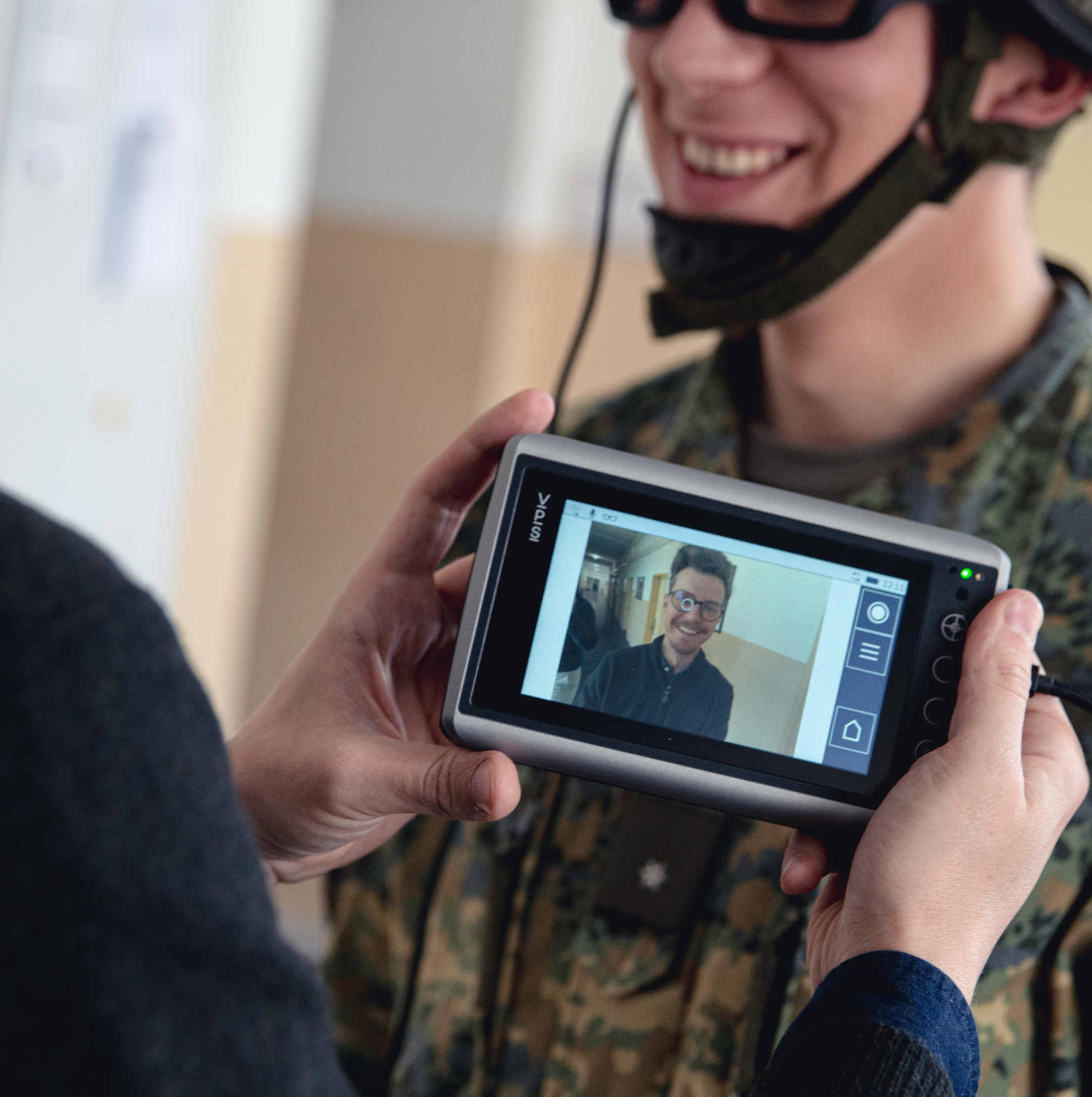
At ECEM 2026 (the European Conference on Eye Movements), a Viewpointsystem research team consisting of Norick R. Bowers, Alejandro H. Gloriani, Katarzyna Kuzmicz-Kowalska, and Roman Schmied presented a method for classifying rotational VOR from wearable eye-tracking data in naturalistic conditions.
The algorithm works in two steps. First, it flags candidate segments where both the eye and head are rotating faster than a set threshold, while the similarity between their directions of rotation, measured using cosine similarity, falls below a second threshold, indicating the two are moving in near opposite directions. Second, it filters out likely false positives, discarding segments that are too short or too noisy to be reliable. The whole process runs in real time, without post-hoc processing.
The team tested the approach on two kinds of data: First, a simple self-recorded head-nod-and-shake test. Then a more complex, naturalistic case: a professional dancer performing warm-up exercises while wearing the eye tracker. In both cases, the algorithm successfully identified VOR segments, including more complex sequences involving combined head and eye movement, where a VOR component pairs with a saccade – a case that’s harder to classify because it no longer looks like a “pure” reflexive response.. This is presented as an initial method demonstration rather than a validated clinical study. The goal was to establish feasibility, not to report normative or diagnostic findings.
Why It’s Relevant
Automatic, real-time VOR classification outside constrained lab conditions creates the basis for analyzing VOR components that are difficult to study under Head Impulse Test conditions, particularly gain (the ratio of eye speed to head speed) and binocular coordination, during unconstrained, real-world behavior.
One promising direction is sports and brain-injury screening. VOR gain is thought to shift measurably after a concussion. VOR gain is thought to shift measurably after a concussion but capturing that shift today means getting the patient into a clinic for a Head Impulse Test – not always practical in the minutes or hours after a head impact. A wearable, real-time approach could close that gap: no clinician-administered test, no equipment beyond the glasses, just a brief recording taken on the sideline or in the locker room. Rather than relying on periodic in-clinic assessments, patients recovering from a vestibular or neurological issue could track their own VOR gain from day to day, building a continuous record of recovery instead of a handful of scattered snapshots.
Outlook
As a method demonstration, this work establishes feasibility rather than clinical validity. The next steps would be validating the approach against the Head Impulse Test in larger, independent samples, and exploring its use across the kinds of contexts outlined above, from sports-related concussion screening to long-term vestibular monitoring outside the clinic.