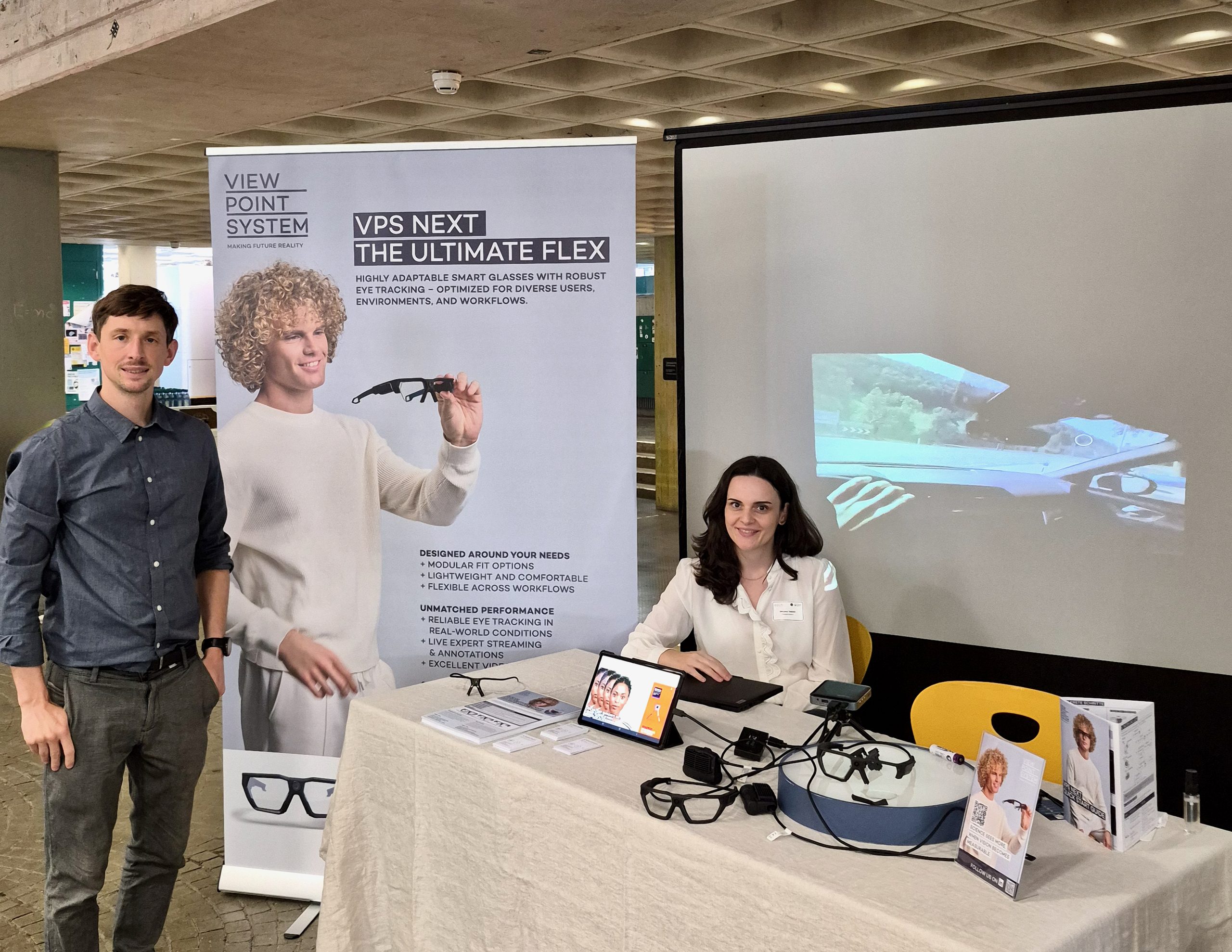
At the 23rd European Conference on Eye Movements (ECEM) in Ulm, Germany, researchers from various disciplines came together to discuss their newest studies conducted with eye tracking technology. In his authentic style, experimental psychologist Ignace Hooge opened the event by declaring that:
“Wearable eye tracking is the future of eye tracking.”
At the same time, his keynote talk made an equally important point: that future is not simply about taking eye trackers out of the lab. Wearable systems have advanced considerably, but studying human attention in the complexity of the real world introduces its own methodological and technological challenges that need to be considered very carefully.
1. “Good enough” depends on the research question
What makes an eye tracker suitable for research?
Accuracy, precision and data loss are obvious parts of the answer. But Hooge raised a more fundamental question: What is good enough?
What does a gaze estimation error of three degrees actually mean in practice? The same level of accuracy might be sufficient to investigate eye contact between people at a distance of 50 centimeters, but insufficient when the distance increases to 1.5 meters.
In other words, a performance metric alone does not tell a researcher whether an eye tracker is suitable. Data quality becomes meaningful in relation to the phenomenon being studied and the conditions under which it is measured.
This becomes particularly relevant with wearable systems. A static accuracy test under optimal conditions can establish an upper limit for performance. But it does not necessarily tell us how a device will perform when a participant walks, turns their head, speaks, or changes facial expression. Hooge therefore distinguished between static and context-specific dynamic testing that better reflects actual use conditions.
For wearable eye tracking, this is an important shift in perspective. Technical specifications matter, but so does understanding how those specifications translate into a particular study.
For us as a technology provider, this is a valuable reminder that researchers cannot simply rely on impressive technical specification numbers but need to be able to make informed decisions about whether a system can provide the data their research question requires.
2. Wearable eye tracking is changing not just where we study behavior, but what we can study
The appeal of wearable eye tracking is often described in terms of allowing researchers to leave the lab. However, it enables an important conceptual change irrespective of spatial terms.
Some aspects of human behavior are difficult to separate from the context in which they occur. We look at other people, follow their gaze to establish joint attention, coordinate our behavior and respond to dynamic environments. In these cases, rather than a variable to control, context invites itself to become part of the research question.
That opportunity was visible at ECEM in research on joint attention and social interaction. And it reflects a broader development in wearable eye tracking: moving beyond paradigms in which one participant observes predetermined stimuli towards research in which several people can interact freely within a shared environment.
That is where we see some of the greatest potential of wearable eye tracking. Even before one leaves the lab, there is a wealth of research questions that the newly gained freedom of movement allows to address.
3. In the real world, robustness becomes part of research quality
Greater freedom also comes at a price: the real world introduces noise from various uncontrollable sources.
Participants move in unexpected ways. Lighting changes. Eye-tracking glasses can slip. Both the device and analysis tools encounter unique conditions that are difficult to reproduce in a controlled test setting. And great hurdles appear from surprisingly mundane sources.
Hooge highlighted another side of real-world research that rarely appears in device specifications: eye tracking failing intermittently, devices dropping out and phones or apps crashing. His deliberately unglamorous wish for the field:
“A Toyota Corolla wearable eye tracker (not cool, but very reliable).”
Behind his humor lies an important observation: Reliability and robustness are not merely usability features. If technical instability leads to missing data, participant exclusions or data that cannot answer the intended question, it can undermine the validity of the study as a whole.
This is why we believe progress in wearable eye tracking should be measured by how confidently researchers can use that technology when conditions are less than ideal.
4. Better technology does not remove methodological responsibility
Another temptation that comes with technological progress is to assume that increasingly sophisticated tools will remove much of the complexity from conducting research.
By considering areas of interest (AOI), Hooge offered a more nuanced picture. In controlled experiments, gaze can often be mapped onto a stable reference frame such as a screen or table, followed by a conventional AOI analysis. With unrestricted movement in the real world, that approach can quickly prove less useful. More promising alternative, automatic image segmentation, for example, can significantly reduce manual effort and make projects feasible that would otherwise be prohibitively labor-intensive.
However, as Hooge notes: “A segmented part is not an AOI yet.”
Whether a marked area constitutes a meaningful AOI still depends on the task, the research question and the quality of the underlying data. With recent technological improvements, tasks that once required extensive manual annotation or highly specialized technical expertise have become more accessible. But this does not remove the need for sound study design, careful piloting and an understanding of the limitations of the data.
Hooge highlighted that researchers should pilot not only their experimental procedure but also the entire data-processing pipeline. Otherwise, complexity that seemed to have disappeared at the beginning of a study can return as substantial manual work at the end.
For technology providers, there is an important lesson here too. As impressive as it may be, technological advancement does not make conducting research simpler. But rather, it enables tackling increasingly more complex phenomena. Hence, our goal is to provide technology which constitutes as small of an obstacle as possible, while giving researchers the confidence and transparency they need to make their own informed methodological decisions.
The future of wearable eye tracking is a shared challenge
These four perspectives provide important context to the idea that wearable eye tracking is the future of eye tracking.
The field has advanced tremendously. Wearable eye tracking systems are better, research setups are more ambitious, and questions that would once have been difficult to investigate empirically are becoming accessible.
But researchers need to know whether data is good enough for their research question. They need systems that continue to perform when experiments become dynamic and unpredictable. And they need technology that supports rigorous research rather than obscuring its complexity.
This is where we see our contribution. As a technology provider, we bring our expertise and ideas to the development of wearable eye tracking. At the same time, staying in close exchange with the people who push the technology into new research contexts helps us understand what researchers need and where current limitations lie.
ECEM 2026 gave us a wealth of new insights and impressions to return energized to work on our part: improving the eye tracking technology.