The Gap Has Shifted, Not Closed
For years, the debate around women in tech has focused on the pipeline: too few women studying STEM, too few entering technical roles, too few joining the industry. While those challenges haven’t disappeared, they no longer tell the full story.
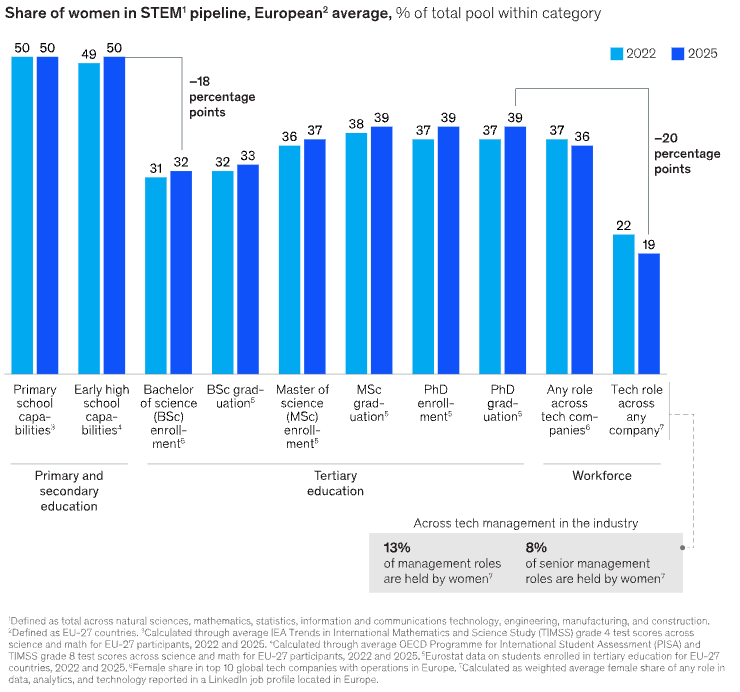
According to McKinsey & Company, women today hold only around 19% of high-tech roles in Europe – down from 22% just three years ago. More striking, however, is how the gap widens over time. Women represent roughly 13% of management roles in tech, and just 8% at senior leadership level, including director and C-level positions.
The issue, in other words, is not only who enters the industry, but who advances within it.
Where Careers Stall – and Why It Matters Now
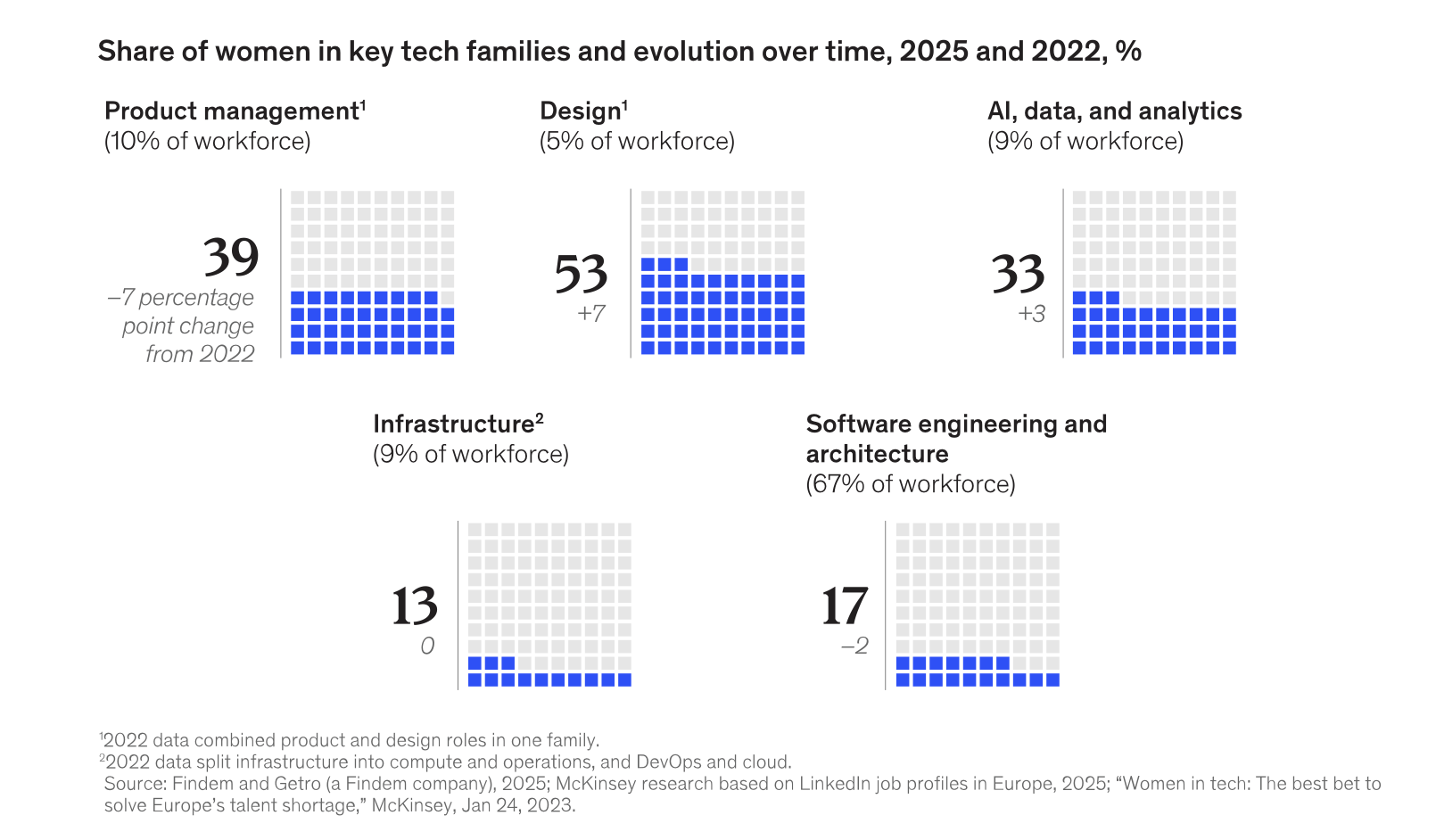
The data points to a consistent pattern: women are present in the workforce but unevenly distributed across roles and levels. They are more likely to work in areas such as product coordination, UX, or delivery. These functions are critical, but often less directly connected to core technical decision-making and long-term strategic influence. At the same time, the roles that define systems, drive architecture, and lead emerging fields like AI remain disproportionately male-dominated.
The biggest drop-off happens in the transition from early career to first leadership roles, the point where responsibility shifts from execution to ownership. Once that step is missed, progression becomes significantly harder.
This dynamic is becoming more critical as AI reshapes the industry. As automation reduces or transforms entry-level and coordination-heavy work, demand is shifting toward skills linked to system design, data, and human–AI interaction. The risk is not just that the gap persists, but that it widens, because the roles most exposed to change are also those where women are currently overrepresented.
From Intent to System Design
These patterns suggest that incremental measures such as more hiring initiatives and more training programs may not be enough.
It raises a different question: how to ensure woman are positioned to grow, lead, and influence the direction of the industry.
To explore what that looks like in practice, we spoke with our Head of People Experience, Jil Perdacher, about what needs to change if the next chapter of tech is going to be more balanced than the last.

Where do you think companies are still solving the wrong problem when it comes to women in tech?
Most companies are still optimizing for entry when the real problem is what happens after. They celebrate hiring numbers, run unconscious bias training, post something on International Women’s Day – and then wonder why their leadership team looks exactly the same five years later. The pipeline was never the real bottleneck. What’s broken is what happens once someone walks through the door: who gets assigned to the high-visibility project, whose idea gets credited in the meeting, who gets pushed to step up versus who gets asked to “support.” Companies measure inputs because inputs are easy to report. But the outcomes: who leads, who shapes strategy, who stays – those require looking at things that are uncomfortable to audit.
If you had to redesign career paths in tech from scratch today, what would you change first?
I’d get rid of the unspoken prerequisite list. Right now, career advancement (not only in tech) runs on a hidden curriculum – informal networks, visibility in the right rooms, a style of self-promotion that rewards specific personalities. If I could redesign from scratch, I’d make progression criteria explicit, observable, and tied to actual impact rather than confidence or who you happen to sit nearby.
I’d also challenge the assumption that leadership means moving away from technical work. Across the industry, I see this pattern repeatedly: some of the most influential people in any tech company are deep specialists – but career ladders rarely reflect that, so management ends up being the only visible route up. That’s a design flaw, not an inevitability. And it’s one that tends to hit certain people harder than others.
What’s a hard truth about gender equality in tech that organizations don’t like to admit?
That most companies aren’t actually trying to fix the system – they’re trying to fix the women. Training women to negotiate better, to be more visible, to build executive presence – that puts the burden of change on the people who didn’t create the problem. If your environment only works well for a narrow type of person, that’s a structural issue, not a talent gap. And addressing it means some people lose an advantage they’ve quietly benefited from for a long time. That’s what makes real change slow, not a lack of good intentions, but a lack of willingness to have that honest conversation with the people who currently hold power.
How do everyday decisions, like who gets staffed on which project, shape long-term career outcomes more than formal policies?
You can have the most beautiful policy document in the world – it doesn’t matter much if the daily decisions tell a different story. When a manager staffs the same person on every high-stakes project because it feels “safer.” When someone gets left off a meeting because they “probably don’t need to be there.” When a stretch opportunity goes to whoever asked loudest rather than whoever was ready. None of that shows up in any policy, but it adds up fast. Over two or three years, those small calls create completely different trajectories for people who started in the same place. That’s why People Experience work has to go beyond writing good policies. The real leverage is in the everyday moments managers don’t even realize are decisions.
What role does visibility play in career progression, and who tends to get it by default?
Visibility is career currency, and it doesn’t get distributed equally. The people who accumulate it naturally tend to be those who are already comfortable taking up space – in meetings, in presentations, inside conversations with senior people. That comfort isn’t random. It’s shaped by whether you’ve seen people like you in those rooms before, whether the environment signals that your voice belongs there. This is true in most industries honestly, but in tech it’s particularly frustrating because there’s this persistent idea that good work speaks for itself. It doesn’t. Work gets noticed when the person doing it is already visible.
Where do you see well-intentioned initiatives backfiring or missing the mark?
Mentoring programs are classic examples. The idea is right, but in practice most programs match junior women with senior women and call it done. That’s not sponsorship; that’s sympathy. What actually moves careers is sponsorship – someone with real organizational weight putting their name behind yours, advocating when you’re not in the room. Mentoring gives advice. Sponsorship gives access.
The other thing I see missing the mark is diversity-focused hiring without anything changing behind it. You bring people in, but the culture still rewards the same behaviors, the same style. People leave, and leadership concludes “it didn’t work” – when really, they only did half the job.
What does a truly inclusive tech career path look like in practice – not in theory?
In practice, a truly inclusive career path means someone can grow without having to become a different person. Advancement criteria are written down and applied the same way regardless of who’s asking. A non-linear path, a sideways move, a deep specialism, coming back from a career gap, doesn’t count against you. Managers are held accountable not just for what their teams deliver, but for how they develop the people on them. We’re actually in a better position than many companies here. At Viewpointsystem, 24% of our team are women, which is already above the European tech average, and a third of our management team is female. That didn’t happen by accident. But I also know it’s not enough to just have the numbers – what matters is whether those people have real influence, real ownership, and a path that keeps growing.